

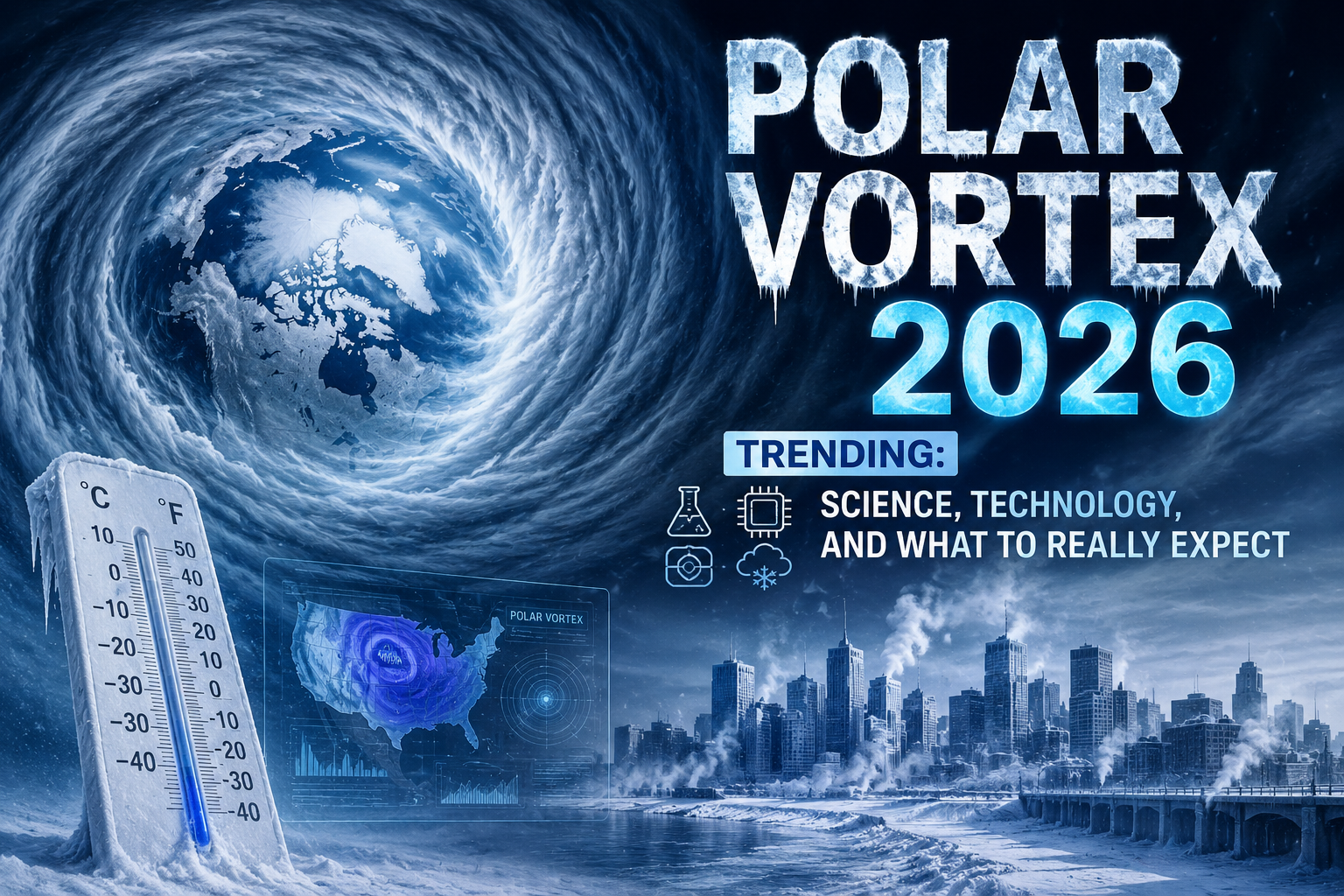
If you have been monitoring digital trends or scrolling through social media recently, you have likely seen the term “Polar Vortex 2026” popping up. The buzz has generated considerable concern, with many wondering if we are on the verge of a historic, severe winter event.
However, in the world of advanced meteorological forecasting, trending does not always mean an imminent apocalypse. While the term sounds intimidating, it is crucial to separate scientific, data-driven facts from social media sensationalism.
What is the Polar Vortex and Why is it Trending?
In Short: The Polar Vortex is a large, persistent area of low pressure and extremely cold air hovering high above Earth’s North and South Poles. When it is strong, its powerful bounding jet stream captures the cold air at the poles. When it is weakened—a process often triggered by a Sudden Stratospheric Warming (SSW) event—the jet stream becomes unstable, allowing freezing Arctic air to spill southward into regions like North America, Europe, or Asia, causing severe cold waves.
Why Trending for 2026? The topic is trending because sophisticated meteorological models and supercomputers have detected early probability indicators of a significant SSW event predicted for early 2026. This has triggered widespread discussion about a high-risk scenario for extreme winter weather.
The Technology Behind the Prediction
We no longer rely on simple observation; modern weather forecasting is a feat of Big Data and Supercomputing:
- Global Simulation Models: Agencies utilize the GFS (Global Forecast System) and ECMWF models to process petabytes of data from satellites and ocean sensors.
- Predictive Algorithms: AI-driven models analyze historical weather patterns to identify “signatures” of an upcoming vortex split weeks before it happens.
- Computational Probability: The 2026 trend is fueled by these models detecting a potential temperature spike in the stratosphere, though it remains a “probability” rather than a “certainty.”
Also Read : Top 10 AI Tools That Are Revolutionizing Marketing in 2026
Will There Be Extreme Cold in 2026?
Based on current technology and atmospheric science, the definitive answer is: It is Too Early to Say for Sure.
- The Time Lag: A confirmed disruption in the stratosphere typically takes 7 to 28 days to filter down to the surface where we live.
- Location Uncertainty: Even if the Polar Vortex splits, it is computationally difficult to predict exactly where the cold air will land. It could hit the USA, Europe, or Siberia, or it might stay over uninhabited regions.
- Severity Varies: Not every disruption results in a record-breaking freeze; some only cause a slightly extended winter or moderate cold spells.
Frequently Asked Questions (FAQs)
Does a Polar Vortex disruption mean a major blizzard is guaranteed?
No. The Polar Vortex brings the cold air, but a blizzard requires a combination of that cold air and a source of moisture (like an ocean) to intersect.
Is Polar Vortex 2026 a confirmed disaster?
No. It is a predictive scenario based on atmospheric modeling. While the data shows a high risk of disruption, weather systems are chaotic and can shift rapidly.
Which countries are usually affected?
Primarily countries in the Northern Hemisphere, including the USA, Canada, UK, Germany, Russia, and parts of Northern Asia. Further south, the effect is usually felt as a significant but less extreme cold wave.
How can I track real-time Polar Vortex data?
You can follow official updates from organizations like NOAA or use visualization tools like Windy.com to monitor the 10hPa pressure level where the vortex resides.
Conclusion: Data Over Hype
Polar Vortex 2026 Trending represents a surge in public interest in weather science, but it also highlights how easily scientific terminology can be misinterpreted. While our most advanced supercomputers indicate a real risk of disruption in 2026, this is a prediction of increased probability, not a guaranteed apocalypse.
For the most reliable updates, avoid sensationalized social media headlines and rely on established meteorological experts who synthesize this complex data into actionable forecasts. Staying informed through authoritative sources is the best way to prepare for whatever the 2026 winter actually brings.