
Remember the frustration of asking a “smart” assistant a simple question, only to watch a glowing ring spin for five seconds because your Wi-Fi flickered? In 2026, that annoying lag is becoming a relic of the past. The intelligence that once lived in massive, distant data centers is now migrating directly onto the silicon inside your pocket.
The Great Migration: From Data Centers to Your Pocket
For the last decade, our interaction with artificial intelligence followed a predictable path. You spoke, your voice was digitized and sent to a server farm hundreds of miles away, processed, and then sent back. It worked, but it was clunky, slow, and felt like a compromise.
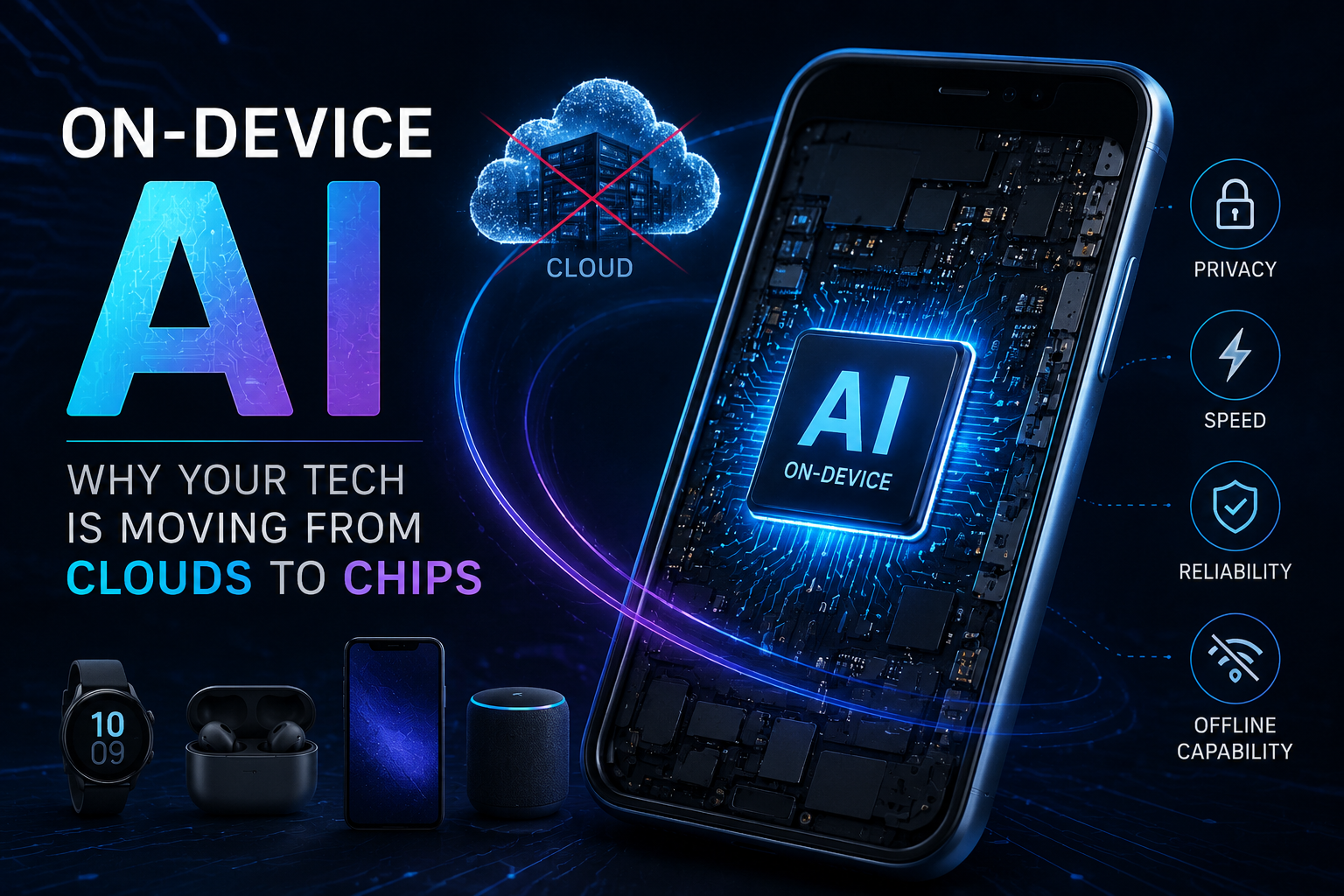
Today, the narrative has shifted. We are seeing a fundamental change in how hardware is built. Silicon manufacturers are no longer just bragging about raw CPU speeds; they are competing over “TOPS” (Trillions of Operations Per Second) dedicated solely to neural processing. This shift isn’t just a technical flex—it’s a response to what we actually need from our tech.
Privacy: The Ultimate Dealbreaker
The biggest driver behind the move to local processing is trust. In previous years, every request you made to a cloud assistant was technically “shared” with a third party. Even with encryption, the idea of your personal data floating in the cloud felt uneasy for many.
Why local processing wins on privacy:
- Zero-Data Leakage: Your voice recordings and personal files never leave the physical boundaries of your device.
- Encrypted Local Learning: Your phone learns your habits locally. It knows you prefer your coffee at 8:00 AM not because a server told it so, but because it observed it right there on your nightstand.
- Regulator Friendly: With stricter global data laws, on-device AI is the easiest way for companies to stay compliant without compromising on features.
The Need for Speed: Latency is the Enemy
Have you ever tried using an AI translation app in a basement or on a plane with spotty Wi-Fi? The “Cloud Era” made AI a luxury of the well-connected. In 2026, on-device AI has turned it into a utility.
When the model lives on your chip, the response time is instantaneous. We are talking about milliseconds instead of seconds. This speed makes real-time applications possible, such as:
- Instant Live Translation: Having a fluid conversation with someone in a different language without the “buffering” silence.
- Real-time Video Enhancement: Applying complex cinematic filters and noise reduction to your video calls as they happen, not after you record them.
- Proactive Assistance: Your device can anticipate your next move—like pulling up your gym QR code as you walk through the door—without needing to “check in” with a server.
Battery Life and Efficiency: The Silicon Secret
It sounds counterintuitive. Wouldn’t running a complex AI model on your phone drain the battery faster than just sending a text to a server? Surprisingly, the answer is no.
Modern Neural Processing Units (NPUs) are incredibly efficient. Sending data over 5G or Wi-Fi is actually an energy-intensive process for a smartphone. By keeping the workload local and using specialized “low-power” cores, manufacturers have found that they can actually extend battery life. Your phone does more work, but it does it much smarter.
Real-Life Impact: The “Silent” Assistant
We often think of AI as something we talk to, like Siri or Alexa. But the 2026 version of on-device AI is often invisible. It’s the “Silent Assistant.”
Take, for example, a modern digital professional. Their laptop now uses local AI to automatically transcribe meetings, summarize long PDF documents, and even suggest email replies based on their unique writing style—all while they are completely offline. There is no subscription fee for “cloud compute,” and there is no risk of a sensitive document being leaked to a public training set.
Breaking the Tether: AI for the Offline World
One of the most practical benefits of this shift is accessibility. For users in areas with poor infrastructure or for travelers in remote locations, cloud AI was effectively useless. On-device AI democratizes intelligence.
If you are hiking in a remote area and need to identify a plant or translate a sign, your device doesn’t need a cell tower. The knowledge is already there, baked into the hardware. This “offline-first” approach is changing how we interact with the world around us.
Are Cloud-Based Assistants Dead?
It would be an exaggeration to say the cloud is useless. Large Language Models (LLMs) that require massive amounts of data—like those used for complex medical research or massive coding projects—will still need the horsepower of the cloud.
However, for 90% of our daily tasks, the cloud is becoming the “backup” rather than the “primary.” We are moving toward a hybrid model where your device handles the personal, immediate tasks, and only “calls home” when it needs to solve an incredibly complex problem.
Actionable Tips for the Modern Tech User
How can you take advantage of this shift right now?
- Check Your Hardware: If you are upgrading your phone or laptop, look for terms like “NPU” or “Neural Engine.” These are more important for future-proofing than traditional RAM or CPU specs.
- Audit Your Privacy: Look for apps that offer “Offline Mode” for AI features. This usually means they are processing data locally.
- Experiment Offline: Try using your voice-to-text or photo search features while in Airplane Mode. You might be surprised at how much your device can already do without the internet.
Conclusion: The Intelligence is Yours
The shift to on-device AI is a return to the original promise of personal computing: that the tool in your hand belongs to you. By removing the middleman—the cloud—we gain privacy, speed, and reliability.
As we move further into 2026, the question won’t be “What can the cloud do for me?” but rather “How smart is the device in my pocket?” The era of the spinning loading ring is over. The era of the truly personal, private assistant has arrived.