
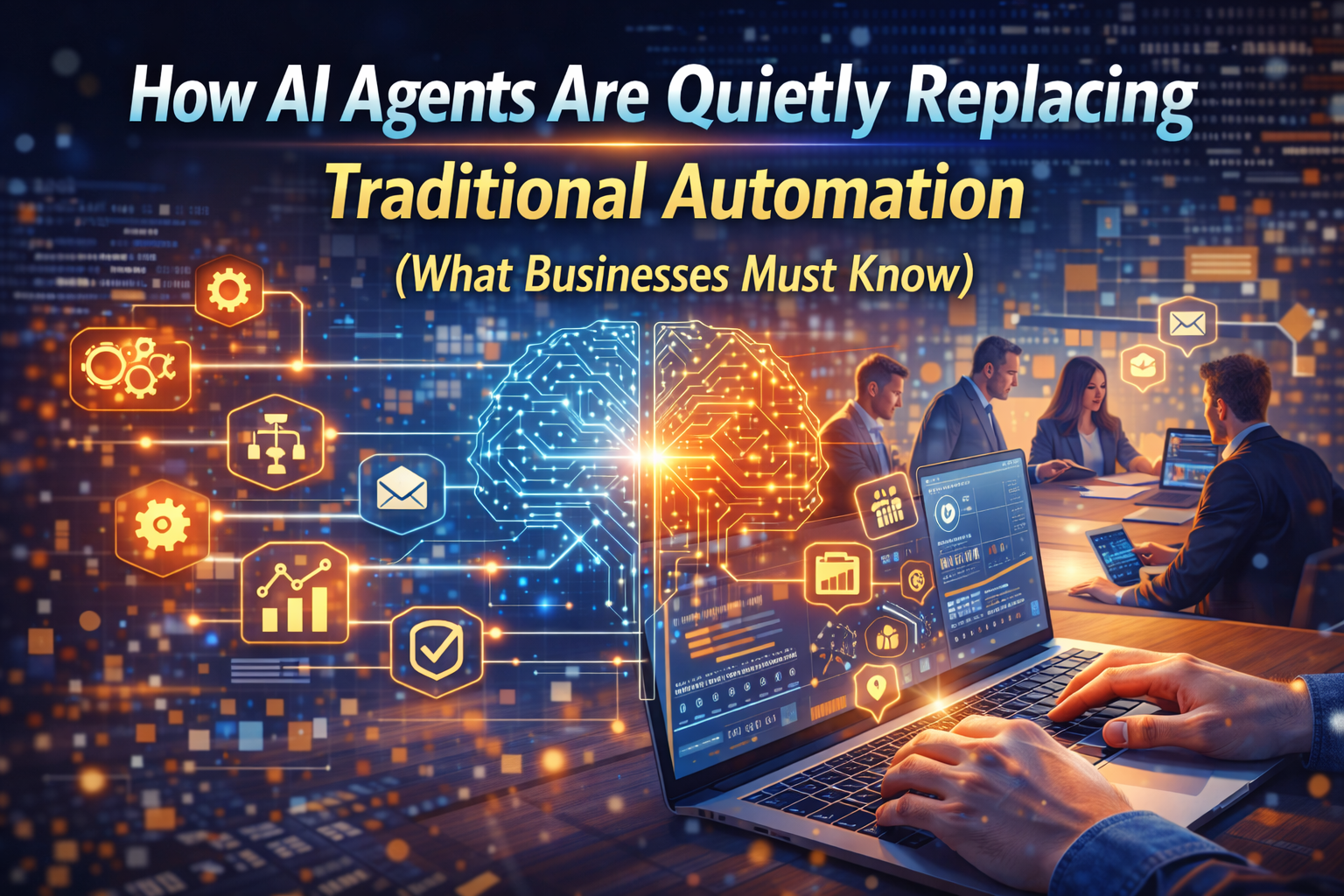
AI agents are rapidly replacing traditional automation by making systems more autonomous, adaptive, and decision-driven. Unlike rule-based automation, AI agents can plan tasks, learn from data, interact with tools, and collaborate with humans in real time. Businesses adopting AI agents are seeing faster workflows, lower operational costs, and smarter decision-making across marketing, customer support, software development, and operations. Understanding how AI agents work — and where traditional automation fails — is becoming essential for staying competitive.
What Are AI Agents (In Simple Terms)?
AI agents are autonomous software systems that can:
- Understand goals
- Decide next steps
- Use tools and APIs
- Learn from feedback
- Act without constant human input
Unlike traditional automation, AI agents don’t just follow rules — they reason, adapt, and optimize outcomes.
Traditional Automation vs AI Agents
Traditional automation relies on:
- Fixed workflows
- Predefined rules
- Manual updates
- Limited flexibility
AI agents, on the other hand:
- Adapt to changing inputs
- Handle unstructured data
- Make contextual decisions
- Improve over time
This shift is why businesses are moving away from rigid automation systems toward agent-based AI workflows.
Where AI Agents Are Replacing Automation First
1. Marketing & Content Operations
AI agents now:
- Plan content calendars
- Generate, refine, and optimize content
- Analyze performance and adjust strategy
This evolution aligns closely with modern AI trends 2026, where automation is no longer static.
2. Customer Support
Instead of simple chatbots, AI agents:
- Understand intent
- Escalate intelligently
- Resolve complex issues
- Learn from past conversations
This reduces human workload while improving customer satisfaction.
3. Software Development
AI agents assist developers by:
- Writing and reviewing code
- Running tests
- Debugging intelligently
- Managing deployment pipelines
This directly impacts tech skills 2026, where developers are expected to collaborate with AI, not compete against it.
4. Business Operations & Decision-Making
AI agents now:
- Monitor KPIs
- Trigger actions automatically
- Recommend strategic decisions
- Predict operational risks
Companies using AI agents report faster responses and better outcomes than rule-based automation.
Why Businesses Are Adopting AI Agents So Fast
Key reasons include:
- Reduced operational costs
- Faster execution
- Better scalability
- Improved accuracy
- Lower dependency on manual oversight
As a result, AI agents are becoming central to the future of artificial intelligence in business.
Risks & Challenges to Understand
AI agents are powerful, but not risk-free:
- Data quality issues
- Security vulnerabilities
- Over-automation without human oversight
- Ethical and compliance concerns
This is why AI agent adoption must be paired with cybersecurity awareness and governance.
What This Means for the Future of Work
AI agents won’t replace humans — but humans who use AI agents will replace those who don’t.
Future professionals will need:
- AI literacy
- Critical thinking
- Oversight and validation skills
- Ethical decision-making
This is especially relevant for AI careers in Europe, where regulation and responsibility matter.
Final Thoughts
AI agents represent a major shift from traditional automation to intelligent, adaptive systems. Businesses that understand and adopt AI agents early will gain a competitive edge, while those relying solely on rule-based automation risk falling behind.
The transition is already happening — quietly, but rapidly.